Tutorial: Model order reduction with machine learning methods
Recent success of machine learning methods such as artificial neural networks or
kernel approaches led to the development of several
methods for model order reduction using machine learning surrogates. pyMOR provides the
functionality for a simple approach developed by Hesthaven and Ubbiali in [HU18].
For training and evaluation of the neural networks, PyTorch is used.
Kernel methods are implemented in pyMOR based on the vectorial kernel orthogonal
greedy algorithm (VKOGA), see VKOGARegressor.
In this tutorial we will learn about feedforward neural networks and greedy kernel methods, the basic idea of the approach by Hesthaven and Ubbiali, and how to use it in pyMOR. Furthermore, we discuss an adaptive model hierarchy that combines machine learning surrogates with reduced basis reduced order models to obtain certified solutions in an efficient way.
Feedforward neural networks
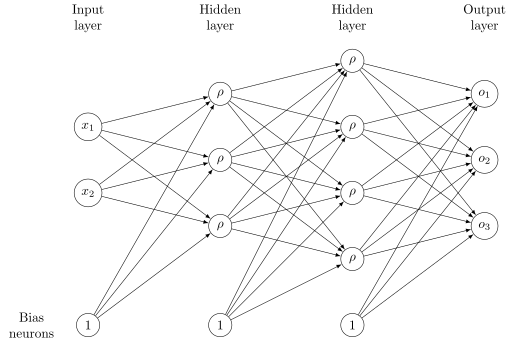
We aim at approximating a mapping \(h\colon\mathcal{P}\rightarrow Y\) between some input space \(\mathcal{P}\subset\mathbb{R}^p\) (in our case the parameter space) and an output space \(Y\subset\mathbb{R}^m\) (in our case the reduced space), given a set \(S=\{(\mu_i,h(\mu_i))\in\mathcal{P}\times Y: i=1,\dots,N\}\) of samples, by means of an artificial neural network. In this context, neural networks serve as a special class of functions that are able to “learn” the underlying structure of the sample set \(S\) by adjusting their weights. More precisely, feedforward neural networks consist of several layers, each comprising a set of neurons that are connected to neurons in adjacent layers. A so-called “weight” is assigned to each of those connections. The weights in the neural network can be adjusted while fitting the neural network to the given sample set. For a given input \(\mu\in\mathcal{P}\), the weights between the input layer and the first hidden layer (the one after the input layer) are multiplied with the respective values in \(\mu\) and summed up. Subsequently, a so-called “bias” (also adjustable during training) is added and the result is assigned to the corresponding neuron in the first hidden layer. Before passing those values to the following layer, a (non-linear) activation function \(\rho\colon\mathbb{R}\rightarrow\mathbb{R}\) is applied. If \(\rho\) is linear, the function implemented by the neural network is affine, since solely affine operations were performed. Hence, one usually chooses a non-linear activation function to introduce non-linearity in the neural network and thus increase its approximation capability. In some sense, the input \(\mu\) is passed through the neural network, affine-linearly combined with the other inputs and non-linearly transformed. These steps are repeated in several layers.
The following figure shows a simple example of a neural network with two hidden layers, an input size of two and an output size of three. Each edge between neurons has a corresponding weight that is learnable in the training phase.
To train the neural network, one considers a so-called “loss function”, that measures how the neural network performs on the training parameters \(S\), i.e. how accurately the neural network reproduces the output \(h(\mu_i)\) given the input \(\mu_i\). The weights of the neural network are adjusted iteratively such that the loss function is successively minimized. To this end, one typically uses a Quasi-Newton method for small neural networks or a (stochastic) gradient descent method for deep neural networks (those with many hidden layers).
In pyMOR, there exists a training routine for neural networks. This
procedure is part of the fit-method of the
NeuralNetworkRegressor
and it is not necessary to write a custom training algorithm for each specific
problem. The training data is automatically split in a random fashion into
training and validation set. However, it is sometimes necessary to try
different architectures for the neural network to find the one that best fits
the problem at hand. In the regressor, one can easily adjust the number of
layers and the number of neurons in each hidden layer, for instance.
Furthermore, it is also possible to change the deployed activation function.
A possibility to use feedforward neural networks in combination with reduced basis methods will be discussed below. First, we introduce a different machine learning technique based on kernel interpolation. Both methods can be used within pyMOR for model order reduction. It is further possible to employ any regressor for regression problems from scikit-learn.
Greedy kernel methods
Another strategy for function approximation implemented in pyMOR is given by kernel methods. The approach is based on approximations constructed as linear combinations of a kernel function centered at a set of suitably selected points, the so-called centers. The function used for interpolation respectively regression of scalar-valued outputs therefore takes the form
for \(x\in\mathbb{R}^d\) with coefficients \(\alpha_1,\ldots,\alpha_n\in\mathbb{R}\) and centers \(x_1,\ldots,x_n\in\mathbb{R}^d\).
For simplicity, we restrict the description given here to the case of an interpolation problem for given data points \(S=\{(\mu_i,h(\mu_i))\in\mathbb{R}^d\times\mathbb{R}: i=1,\ldots,N\}\). For our application later on, we will assume that \(\mu_1,\ldots,\mu_N\in\mathcal{P}\). Using a representer theorem, one can show that the centers in the interpolant should be chosen as the data points themselves, i.e. \(n=N\) and \(x_i=\mu_i\) for \(i=1,\ldots,n\). The coefficients \(\alpha_i\) can then be computed as solution of a linear system using the interpolation conditions. To be more precise,
Typically, one is interested in a sparse approximation of the kernel interpolant,
in the sense that only a small subset of the set of data points is used as centers.
The remaining question is how to select the data points for the kernel surrogate.
A possible strategy is to use a greedy method for center selection, similar to
the greedy algorithm for parameter selection described in
Tutorial: Building a Reduced Basis. The implementation in pyMOR actually makes use
of the same weak greedy algorithm
as for reduced basis construction. More details on the iterative construction
of the kernel surrogates can be found in the documentation of the
VKOGARegressor and in [WH13]
as well as in [SH21].
A non-intrusive reduced order method using machine learning
We now assume that we are given a parametric pyMOR Model for which we want
to compute a reduced order surrogate Model using a machine learning method.
In this example, we consider the following two-dimensional diffusion problem with
parametrized diffusion, right hand side and Dirichlet boundary condition:
on the domain \(\Omega:= (0, 1)^2 \subset \mathbb{R}^2\) with data functions \(f((x_1, x_2), \mu) = 10 \cdot \mu + 0.1\), \(\sigma((x_1, x_2), \mu) = (1 - x_1) \cdot \mu + x_1\), where \(\mu \in (0.1, 1)\) denotes the parameter. Further, we apply the Dirichlet boundary conditions
We discretize the problem using pyMOR’s built-in discretization toolkit as
explained in Tutorial: Using pyMOR’s discretization toolkit. The full-order model is already
defined in examples:
from pymor.models.examples import two_dimensional_parametric_diffusion
fom = two_dimensional_parametric_diffusion()
Since we employ a single Parameter, and thus use the same range for each
parameter, we can create the ParameterSpace using the following line:
parameter_space = fom.parameters.space((0.1, 1))
The main idea of the approach by Hesthaven et al. is to approximate the mapping
from the Parameters to the coefficients of the respective solution in a
reduced basis by means of a neural network. Thus, in the online phase, one
performs a forward pass of the Parameters through the neural networks and
obtains the approximated reduced coordinates. To derive the corresponding
high-fidelity solution, one can further use the reduced basis and compute the
linear combination defined by the reduced coefficients. The reduced basis is
created via POD.
The method described above is “non-intrusive”, which means that no deep insight into the model or its implementation is required and it is completely sufficient to be able to generate full order snapshots for a randomly chosen set of parameters. This is one of the main advantages of the proposed approach, since one can simply train a neural network, check its performance and resort to a different method if the neural network does not provide proper approximation results.
Further, the method is actually independent of the particular machine learning approach. It is therefore possible to use, for instance, kernel methods instead of neural networks as originally proposed in [HU18]. In pyMOR, the implementation can deal with any regressor fulfilling the scikit-learn interface. The neural networks and the kernel methods are implemented in pyMOR in such a way that they also follow the scikit-learn interface and the reductor only requires such a regressor. In this tutorial, we will compare neural networks and kernel methods and show how they can be trained and used in the context of model order reduction.
To train the machine learning surrogates, we create a set of training parameters
consisting of 100 randomly chosen parameter values:
training_parameters = parameter_space.sample_uniformly(100)
In this tutorial, we construct the reduced basis such that no more modes than
required to bound the l2-approximation error by a given value are used.
The l2-approximation error is the error of the orthogonal projection (in the
l2-sense) of the training snapshots onto the reduced basis. That is, we
prescribe l2_err in the POD method. It is also possible to determine a relative
or absolute tolerance (in the singular values) that should not be exceeded on
the training parameters. Further, one can preset the size of the reduced basis.
The construction of the reduced basis is independent of the machine learning
surrogate and is therefore not part of the reductor. The reduced basis has to be
computed beforehand and provided (together with the reduced coefficients, for
instance the coefficients with respect to the reduced basis of the orthogonal
projection onto the reduced space) to the reductor. Within the reductor, mainly
the training of the regressor using the correct data formats is performed and
suitable reduced models are constructed.
We start by collecting the training snapshots associated to the training parameters:
training_snapshots = fom.solution_space.empty(reserve=len(training_parameters))
for mu in training_parameters:
    training_snapshots.append(fom.solve(mu))
We now initialize regressors for feedforward neural networks
from pymor.algorithms.ml.nn import FullyConnectedNN, NeuralNetworkRegressor
neural_network = FullyConnectedNN(hidden_layers=[30, 30, 30])
nn_regressor = NeuralNetworkRegressor(neural_network, tol=1e-3)
and kernel methods
from pymor.algorithms.ml.vkoga import GaussianKernel, VKOGARegressor
kernel = GaussianKernel(length_scale=1.0)
vkoga_regressor = VKOGARegressor(kernel=kernel, criterion='fp', max_centers=30, tol=1e-6, reg=1e-12)
Finally, we construct data-driven reductors using the different regressors
and call the respective reduce-method to start the training process:
from pymor.reductors.data_driven import DataDrivenPODReductor
nn_reductor = DataDrivenPODReductor(training_parameters, training_snapshots,
                                    regressor=nn_regressor, pod_params={'l2_err': 1e-5})
nn_rom = nn_reductor.reduce()

vkoga_reductor = DataDrivenPODReductor(training_parameters, training_snapshots,
                                       regressor=vkoga_regressor, pod_params={'l2_err': 1e-5})
vkoga_rom = vkoga_reductor.reduce()
We are now ready to test our reduced models by solving for a random parameter value the full problem and the reduced models and visualize the result:
mu = parameter_space.sample_randomly()

U = fom.solve(mu)
# Neural network based model
U_red_nn = nn_rom.solve(mu)
U_red_nn_recon = nn_reductor.reconstruct(U_red_nn)
# Kernel based model
U_red_vkoga = vkoga_rom.solve(mu)
U_red_vkoga_recon = vkoga_reductor.reconstruct(U_red_vkoga)

fom.visualize((U, U_red_nn_recon, U_red_vkoga_recon),
              legend=(f'Full solution for parameter {mu}', f'Reduced solution using NN for parameter {mu}',
                      f'Reduced solution using VKOGA for parameter {mu}'))
Finally, we measure the error of our neural network and kernel surrogates
and the performance in terms of computational speedup compared to the
solution of the full order problem for some test parameters.
To this end, we sample randomly
some parameter values from our ParameterSpace:
test_parameters = parameter_space.sample_randomly(10)
Next, we create empty solution arrays for the full and reduced solutions and an empty list for the speedups:
U = fom.solution_space.empty(reserve=len(test_parameters))
U_red_nn = fom.solution_space.empty(reserve=len(test_parameters))
U_red_vkoga = fom.solution_space.empty(reserve=len(test_parameters))

speedups_nn = []
speedups_vkoga = []
Now, we iterate over the test parameters, compute full and reduced solutions to the respective parameters and measure the speedup:
import time

for mu in test_parameters:
    tic = time.perf_counter()
    U.append(fom.solve(mu))
    time_fom = time.perf_counter() - tic

    # Neural network based model
    tic = time.perf_counter()
    U_red_nn.append(nn_reductor.reconstruct(nn_rom.solve(mu)))
    time_red_nn = time.perf_counter() - tic
    speedups_nn.append(time_fom / time_red_nn)

    # Kernel based model
    tic = time.perf_counter()
    U_red_vkoga.append(vkoga_reductor.reconstruct(vkoga_rom.solve(mu)))
    time_red_vkoga = time.perf_counter() - tic
    speedups_vkoga.append(time_fom / time_red_vkoga)
We can now derive the absolute and relative errors on the training parameters as
absolute_errors_nn = (U - U_red_nn).norm()
relative_errors_nn = absolute_errors_nn / U.norm()

absolute_errors_vkoga = (U - U_red_vkoga).norm()
relative_errors_vkoga = absolute_errors_vkoga / U.norm()
The average absolute errors amount to
import numpy as np

print(f"Neural network: {np.average(absolute_errors_nn)}")
print(f"Kernel method: {np.average(absolute_errors_vkoga)}")
Neural network: 0.03355825853463897
Kernel method: 0.015427601650810493
On the other hand, the average relative errors are
print(f"Neural network: {np.average(relative_errors_nn)}")
print(f"Kernel method: {np.average(relative_errors_vkoga)}")
Neural network: 0.00040630335252026493
Kernel method: 0.00017333922965424462
Using machine learning results in the following median speedups compared to solving the full order problem:
print(f"Neural network: {np.median(speedups_nn)}")
print(f"Kernel: {np.median(speedups_vkoga)}")
Neural network: 14.131169921689557
Kernel: 24.385286969546023
Since DataDrivenReductor only uses the provided
training data, the approach presented here can easily be applied to Models
originating from external solvers, without requiring any access to Operators
internal to the solver. Examples using FEniCS for stationary and instationary problems
together with the DataDrivenReductor are provided
in data_driven_fenics and
data_driven_instationary demo scripts.
Furthermore, the strategy is also applicable when no full-order model is available at all.
Given a set of training snapshots (for instance read from a file), a reduced basis can be
computed using a data-driven compression method such as POD, the snapshots can be
projected onto the reduced basis and the machine learning training is handled by the
data-driven reductor as shown before.
Direct approximation of output quantities
Thus far, we were mainly interested in approximating the solution state \(u(\mu)\equiv u(\cdot,\mu)\) for some parameter \(\mu\). If we consider an output functional \(\mathcal{J}(\mu):= J(u(\mu), \mu)\), one can use the reduced solution \(u_N(\mu)\) for computing the output as \(\mathcal{J}(\mu)\approx J(u_N(\mu),\mu)\). However, when dealing with supervised machine learning, one could also think about directly learning the mapping from parameter to output. That is, one can use a machine learning surrogate to approximate \(\mathcal{J}\colon\mathcal{P}\to\mathbb{R}^q\), where \(q\in\mathbb{N}\) denotes the output dimension.
In the following, we will extend our problem from the last section by an output functional
and use the DataDrivenReductor with the argument
target_quantity='output' to derive a reduced model that can solely be used to solve
for the output quantity without computing a reduced state at all.
Our problem from above also has two outputs, namely the l2-product of the solution with the right hand side respectively Dirichlet boundary data of our original problem. Consequently, the output dimension is \(q=2\).
We can now use again the DataDrivenReductor
(for simplicity we only consider kernel methods here) and initialize the reductor
using output data:
training_outputs = []
for mu in training_parameters:
    training_outputs.append(fom.output(mu)[:, 0])
training_outputs = np.array(training_outputs)

from pymor.reductors.data_driven import DataDrivenReductor
vkoga_output_regressor = VKOGARegressor(kernel=kernel, criterion='fp', max_centers=30, tol=1e-6, reg=1e-12)
output_reductor = DataDrivenReductor(training_parameters, training_outputs,
                                     regressor=vkoga_output_regressor, target_quantity='output')
Observe that we now specified target_quantity='output' instead of the default value
target_quantity='solution' when creating the reductor. On the other hand, we do not need
a reduced basis now since we are solely interested in an approximation of the output.
Similar to the DataDrivenReductor
with target_quantity='solution', we can call reduce to obtain a reduced order model.
In this case, reduce trains the machine learning surrogate to approximate the mapping from
parameter to output directly. Therefore, we can only use the resulting reductor to solve for
the outputs and not for state approximations.
The DataDrivenReductor with
target_quantity='solution' though can be used to do both by calling solve
respectively output (if we had initialized
the DataDrivenReductor with
target_quantity='solution' and the problem including the output quantities).
We now perform the reduction and run some tests with the resulting
DataDrivenModel:
output_rom = output_reductor.reduce()

outputs = []
outputs_red = []
outputs_speedups = []

for mu in test_parameters:
    tic = time.perf_counter()
    outputs.append(fom.output(mu=mu))
    time_fom = time.perf_counter() - tic

    tic = time.perf_counter()
    outputs_red.append(output_rom.output(mu=mu))
    time_red = time.perf_counter() - tic

    outputs_speedups.append(time_fom / time_red)

outputs = np.squeeze(np.array(outputs))
outputs_red = np.squeeze(np.array(outputs_red))

outputs_absolute_errors = np.abs(outputs - outputs_red)
outputs_relative_errors = outputs_absolute_errors / np.abs(outputs)
The average absolute error (component-wise) on the test parameters is given by
np.average(outputs_absolute_errors)
np.float64(0.0009647116357841545)
The average relative error is
np.average(outputs_relative_errors)
np.float64(0.00024333632885764487)
and the median of the speedups amounts to
np.median(outputs_speedups)
np.float64(32.09853774111265)
Machine learning methods for instationary problems
To solve instationary problems using machine learning, we have extended the
DataDrivenReductor to also treat instationary cases,
where time is treated either as an additional parameter (see [WHR19]) or the whole time
trajectory can be predicted at once. In the first case, the input, together
with the current time instance, is passed to the machine learning surrogate in each time step
to obtain reduced coefficients. In the second case, the parameter is used as input and the output of
the machine learning surrogate is the complete time trajectory of reduced coefficients.
In the same fashion, setting target_quantity='output' yields a reduced model for prediction
of output trajectories without requiring information about the solution states.
Instationary machine learning reductors in practice
In the following we apply different machine learning surrogates to a parametrized parabolic
equation. First, we import the parametrized heat equation example from
examples:
from pymor.models.examples import heat_equation_example
fom = heat_equation_example()
product = fom.h1_0_semi_product
We further define the parameter space:
parameter_space = fom.parameters.space(1, 25)
Additionally, we sample training and test parameters from the respective parameter space:
training_parameters = parameter_space.sample_uniformly(15)
test_parameters = parameter_space.sample_randomly(10)
To check how the different reduced models perform, we write a simple function that measures the errors and the speedups on a set of test parameters:
def compute_errors(rom, reductor):
    speedups = []

    U = fom.solution_space.empty(reserve=len(test_parameters))
    U_red = fom.solution_space.empty(reserve=len(test_parameters))

    for mu in test_parameters:
        tic = time.time()
        u_fom = fom.solve(mu)[1:]
        U.append(u_fom)
        time_fom = time.time() - tic

        tic = time.time()
        u_red = reductor.reconstruct(rom.solve(mu))[1:]
        U_red.append(u_red)
        time_red = time.time() - tic

        speedups.append(time_fom / time_red)

    relative_errors = (U - U_red).norm2() / U.norm2()

    return relative_errors, speedups
We now run the DataDrivenReductor using
different machine learning surrogates (VKOGA, VKOGA with time-vectorization,
fully-connected neural network) and evaluate the performance of the
resulting reduced models:
training_snapshots = fom.solution_space.empty(reserve=len(training_parameters))
for mu in training_parameters:
    training_snapshots.append(fom.solve(mu))
It is often useful for the machine learning training to scale inputs and outputs,
for instance using scikit-learn’s MinMaxScaler. This will be incorporated below
as well:
from sklearn.preprocessing import MinMaxScaler

vkoga_regressor = VKOGARegressor()
vkoga_reductor = DataDrivenPODReductor(training_parameters, training_snapshots,
                                       regressor=vkoga_regressor, T=fom.T, time_vectorized=False,
                                       input_scaler=MinMaxScaler(), output_scaler=MinMaxScaler(),
                                       pod_params={'modes': 20})
vkoga_rom = vkoga_reductor.reduce()
rel_errors_vkoga, speedups_vkoga = compute_errors(vkoga_rom, vkoga_reductor)

vkoga_regressor_tv = VKOGARegressor()
vkoga_reductor_tv = DataDrivenPODReductor(training_parameters, training_snapshots,
                                          regressor=vkoga_regressor_tv, T=fom.T, time_vectorized=True,
                                          input_scaler=MinMaxScaler(), output_scaler=MinMaxScaler(),
                                          pod_params={'modes': 20})
vkoga_rom_tv = vkoga_reductor_tv.reduce()
rel_errors_vkoga_tv, speedups_vkoga_tv = compute_errors(vkoga_rom_tv, vkoga_reductor_tv)

nn_regressor = NeuralNetworkRegressor(tol=None, restarts=0)
nn_reductor = DataDrivenPODReductor(training_parameters, training_snapshots,
                                    regressor=nn_regressor, T=fom.T, time_vectorized=False,
                                    input_scaler=MinMaxScaler(), output_scaler=MinMaxScaler(),
                                    pod_params={'modes': 20})
nn_rom = nn_reductor.reduce()
rel_errors_nn, speedups_nn = compute_errors(nn_rom, nn_reductor)
We finally print the results:
print('Results for the state approximation:')
print('====================================')
print()
print('Approach by Hesthaven and Ubbiali using feedforward ANNs:')
print('---------------------------------------------------------')
print(f'Average relative error: {np.average(rel_errors_nn)}')
print(f'Median of speedup: {np.median(speedups_nn)}')
print()
print('Approach by Hesthaven and Ubbiali using VKOGA:')
print('----------------------------------------------')
print(f'Average relative error: {np.average(rel_errors_vkoga)}')
print(f'Median of speedup: {np.median(speedups_vkoga)}')
print()
print('Approach by Hesthaven and Ubbiali using VKOGA (time-vectorized):')
print('----------------------------------------------------------------')
print(f'Average relative error: {np.average(rel_errors_vkoga_tv)}')
print(f'Median of speedup: {np.median(speedups_vkoga_tv)}')
Results for the state approximation:
====================================

Approach by Hesthaven and Ubbiali using feedforward ANNs:
---------------------------------------------------------
Average relative error: 0.023677946219814578
Median of speedup: 17.41563076186051

Approach by Hesthaven and Ubbiali using VKOGA:
----------------------------------------------
Average relative error: 0.1306107049786489
Median of speedup: 27.7963660096394

Approach by Hesthaven and Ubbiali using VKOGA (time-vectorized):
----------------------------------------------------------------
Average relative error: 1.4824190446846621e-05
Median of speedup: 27.77677600419594
We observe that in this example, the time-vectorized version of VKOGA performs best in terms of accuracy and speedup.
Adaptive and certified model hierarchy
The data-driven models we have seen above can also be used in conjunction with traditional projection-based methods. To this end, we can create an adaptive model hierarchy consisting of a full-order model, a reduced basis reduced order model and a machine learning surrogate. For a new parameter, the model hierarchy is evaluated using the following scheme: First, the data-driven model is evaluated. The accuracy of its result is verified by means of an a posteriori error estimator. If the estimated error is smaller than a prescribed tolerance, the result of the data-driven surrogate is returned. In case that the data-driven surrogate is not accurate enough, the reduced order model is called for the current parameter. Again, an a posteriori error estimator is used to quantify the accuracy of the solution. If the reduced basis solution is not sufficiently accurate, the hierarchy falls back to the full-order model. Otherwise, the reduced solution is returned.
The hierarchy always tries the faster models first, until a solution is obtained that fulfills the accuracy requirements. Whenever the hierarchy has to call more costly models (i.e. the reduced basis model or the full-order model) training data for the cheaper models (i.e. the data-driven surrogate or the reduced basis model) is generated. The model hierarchy therefore starts with empty reduced models and extends the reduced basis whenever new training snapshots are available. Similarly, the data-driven surrogate is retrained from time to time when enough training data has been collected from calls to the reduced model.
The model hierarchy was described in detail in [HKO+23].
We now show how to use the model hierarchy in pyMOR. In this example, we consider again the elliptic problem from the beginning of the tutorial.
fom = two_dimensional_parametric_diffusion()
parameter_space = fom.parameters.space((0.1, 1))
Now, we create a factory for a suitable RB reductor that automatically assembles an a posteriori error estimator. The hierarchy builds each level by passing the next higher-fidelity model to such a factory, so instead of a fixed reductor we define a callable that receives the model to reduce:
from pymor.reductors.coercive import CoerciveRBReductor
from pymor.parameters.functionals import ProjectionParameterFunctional
rb_reductor_factory = lambda model: CoerciveRBReductor(
    model, coercivity_estimator=ProjectionParameterFunctional('mu'))
Furthermore, we use again the VKOGARegressor.
When extending the reduced basis in the hierarchy, a new data-driven surrogate for the
additional coefficients is constructed. Since each of these data-driven surrogates is
trained independently and therefore needs its own regressor, we pass a factory
(a callable returning a fresh regressor) rather than a single regressor object.
We further create a factory that builds an
AdaptiveDataDrivenReductor for the data-driven surrogate.
kernel = GaussianKernel(length_scale=1.0)
regressor_parameters = {'kernel': kernel, 'criterion': 'fp', 'max_centers': 30, 'tol': 1e-6, 'reg': 1e-12}
dd_reductor_parameters = {'regressor': lambda: VKOGARegressor(**regressor_parameters)}

from pymor.reductors.data_driven import AdaptiveDataDrivenReductor
dd_reductor_factory = lambda model: AdaptiveDataDrivenReductor(dd_reductor_parameters, fom=model)
We can finally set up the adaptive model hierarchy as a
ModelHierarchy. The hierarchy is built from the
full-order model as the reference together with a sequence of reductor factories
as defined above (rb_reductor_factory and dd_reductor_factory),
ordered from the highest-fidelity reduced model down to the cheapest one.
We also pass the tolerance against which the estimated errors are compared:
tol = 5e-3

from pymor.models.hierarchy import ModelHierarchy
hierarchy = ModelHierarchy(fom, [rb_reductor_factory, dd_reductor_factory], tol)
The model hierarchy can now be used similar to any other model by calling its
compute-method. Some additional data that the model used internally to compute
the solution or the estimated error are also provided in the data dictionary. The
used_model entry is the index of the model that was used, counting from the reference
model (0 is the full-order model, 1 the reduced basis model and 2 the data-driven
surrogate):
parameters = parameter_space.sample_randomly(100)
model_labels = ['FOM', 'RB', 'DD']

timings_red = []
used_models = []
estimated_errors = []
for mu in parameters:
    tic = time.perf_counter()
    data = hierarchy.compute(solution=True, solution_error_estimate=True, mu=mu)
    timings_red.append(time.perf_counter() - tic)
    used_models.append(model_labels[data['used_model']])
    estimated_errors.append(np.max(data['solution_error_estimate']))

timings_red = np.array(timings_red)
estimated_errors = np.array(estimated_errors)
The data we collected above can be visualized to analyze the performance of the adaptive model hierarchy and the models contained in the hierarchy:
import matplotlib.pyplot as plt

model_colors = {'FOM': 'C0', 'RB': 'C1', 'DD': 'C2'}
fig, axes = plt.subplots(1, 3, figsize=(15, 4))

# Model usage counts
models = ('FOM', 'RB', 'DD')
counts = [used_models.count(m) for m in models]
axes[0].bar(models, counts, color=[model_colors[m] for m in models])
axes[0].set_ylabel('count')
axes[0].set_title('Model usage')

# Runtime box plots
timing_data = []
labels = []
colors = []
for model in models:
    idx = [i for i, m in enumerate(used_models) if m == model]
    if idx:
        timing_data.append(timings_red[idx])
        labels.append(model)
        colors.append(model_colors[model])
bplot = axes[1].boxplot(timing_data, patch_artist=True)
axes[1].set_xticklabels(labels)
for patch, color in zip(bplot['boxes'], colors, strict=True):
    patch.set_facecolor(color)
    patch.set_alpha(0.7)
axes[1].set_yscale('log')
axes[1].set_ylabel('time [s]')
axes[1].set_title('Runtimes')

# Estimated errors
for model, marker in (('DD', '*'), ('RB', '.')):
    idx = [i for i, m in enumerate(used_models) if m == model]
    if idx:
        axes[2].plot(idx, estimated_errors[idx], marker,
                     color=model_colors[model], label=model)
axes[2].set_xlabel('parameter index')
axes[2].set_ylabel('error estimate')
axes[2].semilogy()
axes[2].legend()
axes[2].set_title('Estimated errors')

fig.tight_layout()
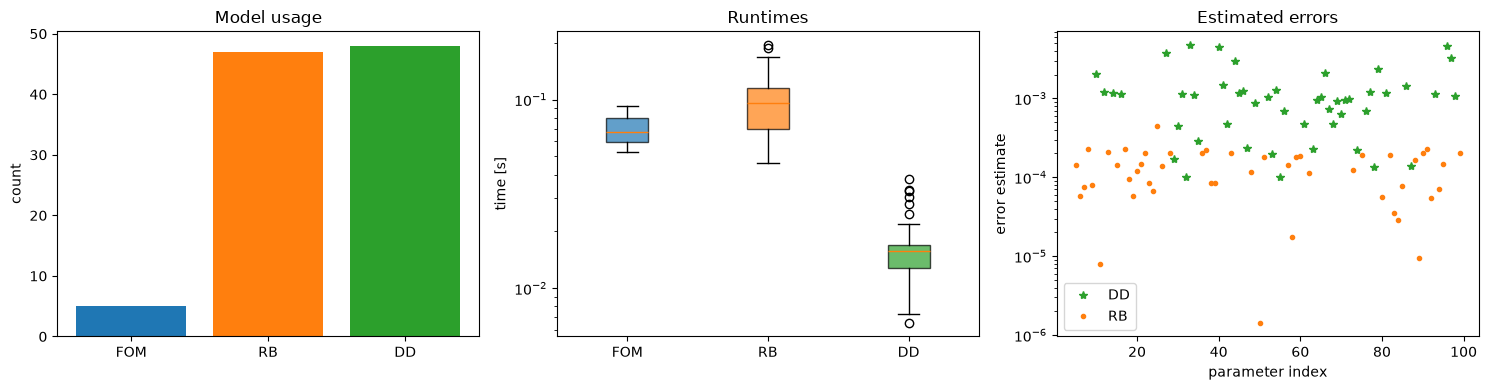
We observe that the data-driven surrogate is the fastest model and is used most often. The reduced basis model is on average slightly slower than the full-order model due to the frequent training of the data-driven model. We expect that the average runtime of the reduced basis model will decrease further when querying the hierarchy more often and less retraining of the data-driven model is required. The full-order model is only used a few times and was never required after building a suitable reduced space. It is important to remark that the runtimes of the full-order model and the reduced basis model also include the training times for the surrogates.
Since ModelHierarchy accepts an arbitrary sequence of
reductor factories, it is not restricted to this particular set of three models. For
instance, we can build a two-level hierarchy consisting only of the reduced basis model
and the full-order model by omitting the data-driven reductor factory:
rb_hierarchy = ModelHierarchy(fom, [rb_reductor_factory], tol)

rb_model_labels = ['FOM', 'RB']
rb_used_models = []
for mu in parameter_space.sample_randomly(20):
    data = rb_hierarchy.compute(solution=True, solution_error_estimate=True, mu=mu)
    rb_used_models.append(rb_model_labels[data['used_model']])

for model in rb_model_labels:
    print(f'{model}: {rb_used_models.count(model)}')
FOM: 4
RB: 16
Download the code:
tutorial_mor_with_ml.md
tutorial_mor_with_ml.ipynb